The Seven Shadows of the Creative Founder
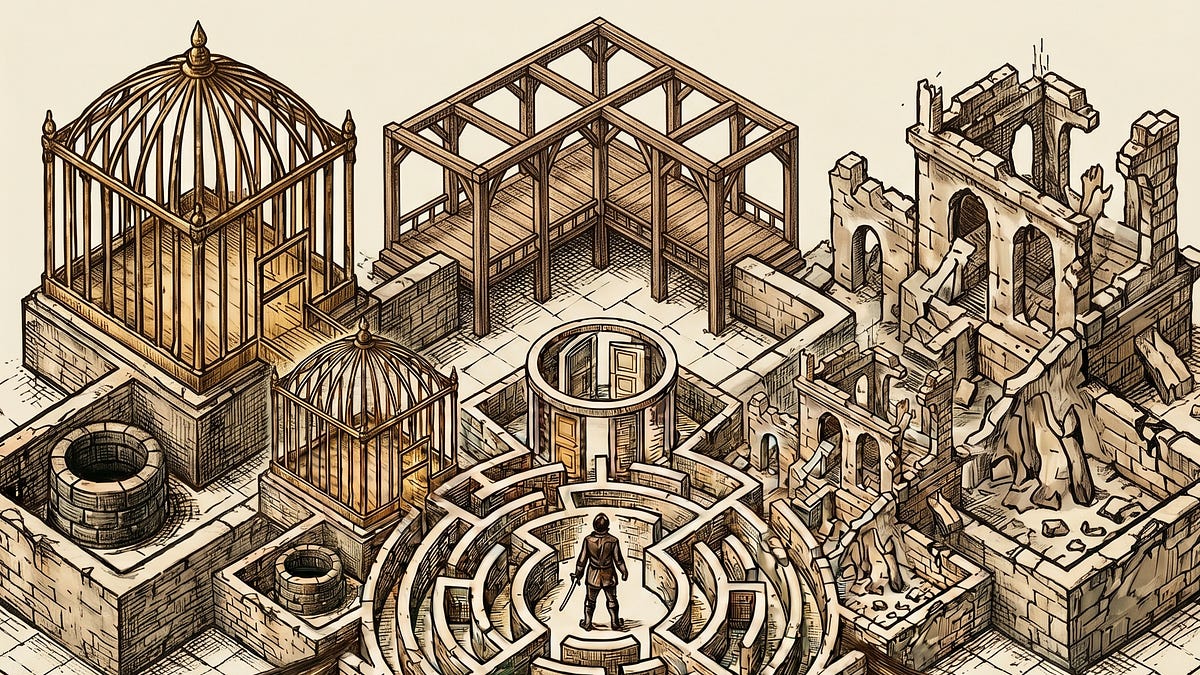
In the Creative Economy, you are the architect of your own world. But every architect, if they are not careful, will eventually build a room they can’t figure out how to leave.
We call these “business constraints,” but let’s be honest: they feel more like demons. To a creative founder, these demons are illusionary shadows. They aren’t literal evil entities; they are the adversities, the challenges, and the misalignments that prevent you from materializing your goals.
They manifest in your journey in distinct ways, and if you are currently feeling like a prisoner of your own brilliance, you are likely locked in a room with one of these seven:
1. The Golden Cage (Quality Dependency)
The illusion here is that your personal touch is the only value. You believe nothing ships without your fingerprints on it. You’ve convinced yourself that you are the most creative person in the room…that your eye for detail is unmatched and your taste is the only one that matters.
You’re scared to leave people to do even the tiniest things. You won’t let them write a caption because “they won’t get the voice right.” You won’t let them handle a client email because “they won’t understand my relationship with that client.” Even when they do exactly what you asked, you still believe it’s inferior simply because it didn’t come from your brain. Now, you spend all your time complaining that you have to do everything yourself. You’ve built a room where you are the only one with the key.
You are in a cage of your own excellence, which means the moment you stop working, the whole palace falls apart.
2. Identity Crisis (The Blurred Reflection)
This is the deepest misalignment because you haven’t realized that personal development is business development. Your identity is so tangled with the company that every internal struggle you have becomes a business constraint. And it manifests in so many different ways:
Before you even get a breakthrough in the market, you are being sabotaged by your own self-doubt and self-condemnation. You beat yourself up over failures or missed milestones, creating internal conflicts that you drag into your company’s culture. You are paralyzed by your own thoughts, overthinking every move and effectively blocking the major breakthroughs or transformations your company needs to move forward. This identity crisis feeds an illusion of scarcity where you genuinely believe you lack money, resources, or opportunities, ensuring you never take the risks necessary to reach the next level. By having an emotional dependency on outcomes, you allow your internal state to be dictated by external results, leading to polarity and negative labeling.
The moment you face adversity, like losing a client or a revenue drought, you label it as a terrible event and bring that negative meaning into your company.
If the founder’s identity is the company’s identity, the company cannot operate; it is trapped by your imagination and limited by your own emotional instability.
3. The Erratic Heartbeat (Revenue Concentration & Pipeline Chaos)
This is the demon of the dysregulated life. It keeps you trapped in a manic cycle of feast and famine. When you’re feasting, you feel invincible and stop hunting because you have big clients and big money. It has you “playing house”…buying subscriptions, hiring aggressively, renting office space like a big company. Now, you have the overhead of a full company conglomerate…and yet, the fragile stability of a freelancer.
But this demon has no memory because the moment the famine hits, and something happens, maybe you lose said big client, you are filled with a frantic, panicking, full-throttle hunt. You come into the office screaming, “There are no clients!” and everyone scrambles in fear. Now there’s a tension in your space, everyone knows that everything is not okay in the company.
You have no data, no projections, and no predictable pipeline. You’re just riding a wave of sporadic adrenaline, and if that one major client changes their mind, your entire “world” disappears overnight and your heart stops.
4. The Scaling Bottleneck (The Paradox of Control)
Growth is blocked because the founder has positioned themselves as the single point of failure for every department. You feel a compulsive need to be inside everything…you are co-signing on finance, accounting, tech, operations, and creativity. You are the one writing the emails, managing the clients, handling the onboarding, building the decks, pitching the vision, and tracking the numbers.
This goes beyond being “needed”; it is a misalignment where you believe your presence is the only thing keeping the world from collapsing.
This creates an illusionary shadow where your “hands-on” leadership is actually a destructive blockage. By refusing to step out, you prevent other departments from maturing and building their own strength. You have effectively become the ceiling of your own company.
The esoteric tragedy here is that the more you try to hold, the less you actually own. You aren’t building a legacy; you are building a machine that can only grow as far as your individual bandwidth allows.
By micro-managing the manifestation of every detail, you have strangled the company’s ability to scale, turning what should be a thriving organism into a reflection of your own inability to trust the process.
5. The Empty Echo (Talent Retention)
This is the reason your office feels like a revolving door…Creatives keep leaving you….
This constraint convinces you that the problem is “poor people”…that you just can’t find good talent anymore or that nobody “gets” the vision. But the truth is you haven’t done the diagnostic on your own leadership. You haven’t built a structure that can actually hold the weight of a team, and you lack a company culture that people can even connect to.
Because you don’t have systems in place, you spend half your life in an exhausting, endless cycle of re-hiring, re-training, and re-explaining your vision to people who won’t stay. You are stuck in a loop of teaching the same basics over and over, wondering why nobody helps you carry the load, never realizing that you haven’t built a house they can actually live in.
It will continuously blind you to the people standing right in front of you. You’ve built a place for people to work for you, but no place for them to grow with you. You treat your team like appendages of your own ego. You don’t give them a quest, a direction, a role, or a vision to believe in and work towards; you just give them tasks to do.
Because you don’t trust them to hold the vision, they never stay long enough to actually see it. You are shouting into a room and only hearing your own voice back.
6. Operational Chaos (The Infinite First)
This is the demon of reinventing the wheel. Because you refuse to document your process, every single project feels like the first day of your business. You have no maps and no systems; you only have a registered business name, an instagram page and a bank account, and the high of a deadline.
You convince yourself that your work is too “bespoke” or “artistic” to be bottled into a procedure, but the reality is just a lack of structure. You are rebuilding the engine while the car is moving at 100mph, repeating Level 1 mistakes over and over again because there is no institutional memory. You aren’t doing “creative” work; you’re just doing inefficient work.
You’re exhausted because you are forced to be the architect and the labourer every single time, trapped in a cycle where the execution never gets easier, only more frantic.
7. The Strategic Void (The Mapless Wanderer)
This is the demon of “doing good work and hoping for the best.” You have the skill and the light, but you have no roadmap beyond the next month. You’ve entered the arena without an end game, driven only by the feeling that you have a “good idea” or a creative spark. Because there is no strategy, there is no understanding of how the game is played…you don’t know who the gatekeepers are, you haven’t anticipated the roadblocks ahead, and you haven’t even had the internal conversation of whether you are truly ready to go all the way.
Are you?
Entrepreneurship is a quest of endurance, yet you are wandering without a compass. This void creates a fragile foundation where, at the first sign of real adversity, everything crumbles.
You aren’t rendering your own reality; you are merely reacting to whatever falls into your lap. Without a North Star, you are effectively lost in the noise, mistaking “being busy” for “being on a mission.”
If you refuse to build a roadmap, you aren’t a founder, you are just a traveler waiting for the world to decide your destination.
I know these shadows because I have lived in them. I built these cages myself, and I spent years trying to find the exit. I’ve shared the raw truth of how I made every single one of these mistakes, and how I fought my way through them, over on my YouTube channel. If you want to see the “behind the scenes” of these failures, watch my story here.
Most founders don’t face all seven at once. Usually, there is one primary demon standing in your path. One shadow that has become your “cage”, and two smaller ones biting at your heels.
You cannot transcend what you refuse to diagnose. To move into your next season, you have to be honest about the architecture you’ve created. Identification is the first step, but execution is the exit.
If you are ready to stop wandering and start building a business that can outlive your own personal bandwidth, I invite you to apply for the CorpCi Founder Labs. This is where we do the hard work of untangling your identity from your infrastructure and building the systems that allow you to scale without burning out.
Apply to CorpCi Founder Labs Here
Which demons are you currently facing?
Get the next memo first.
Saturdays. Direct to your inbox. Free.
Join the builders. No spam. Unsubscribe anytime.